History
Kōtō and the birth of pro sumo
Why Kōtō ward matters to sumo: the shrine where Edo's sanctioned tournaments began, the yokozuna stones and the old farming village of Sunamura.
Reserve a place by the ring ↗Quick answer
Kōtō has a strong claim on sumo's history. Tomioka Hachiman Shrine, in the ward's Fukagawa district, is where the first sanctioned sumo tournament of the Edo period took place in 1684, the start of the professional sport. Its grounds hold the Yokozuna Stone, carved with the names of the sport's grand champions.
From court ritual to street fights
Sumo is far older than Edo. English Wikipedia traces its first written mention to the Kojiki of 712, in a wrestling match between two gods for possession of the islands, and says the Nihon Shoki of 720 dates the first contest between mortals to 23 BC. Over the following centuries it served as a court ceremony, as combat training for samurai and as a popular entertainment. In Edo the wild fighting on the streets became a nuisance, and the shogunate banned sumo in the city for a time.
What Edo left in the ring
Much of what you see at a sumo bout today took shape in the Edo period, English Wikipedia notes: the ring-entering ceremony, the stable system, the gyōji and the mawashi among them. The circular ring is a little older. When the warlord Oda Nobunaga held a tournament of 1,500 wrestlers in 1578, rings were marked out to speed up the bouts and keep spectators safe, and that is counted as the invention of the dohyō, which reached its present form by the 18th century.
1684 at Tomioka Hachiman
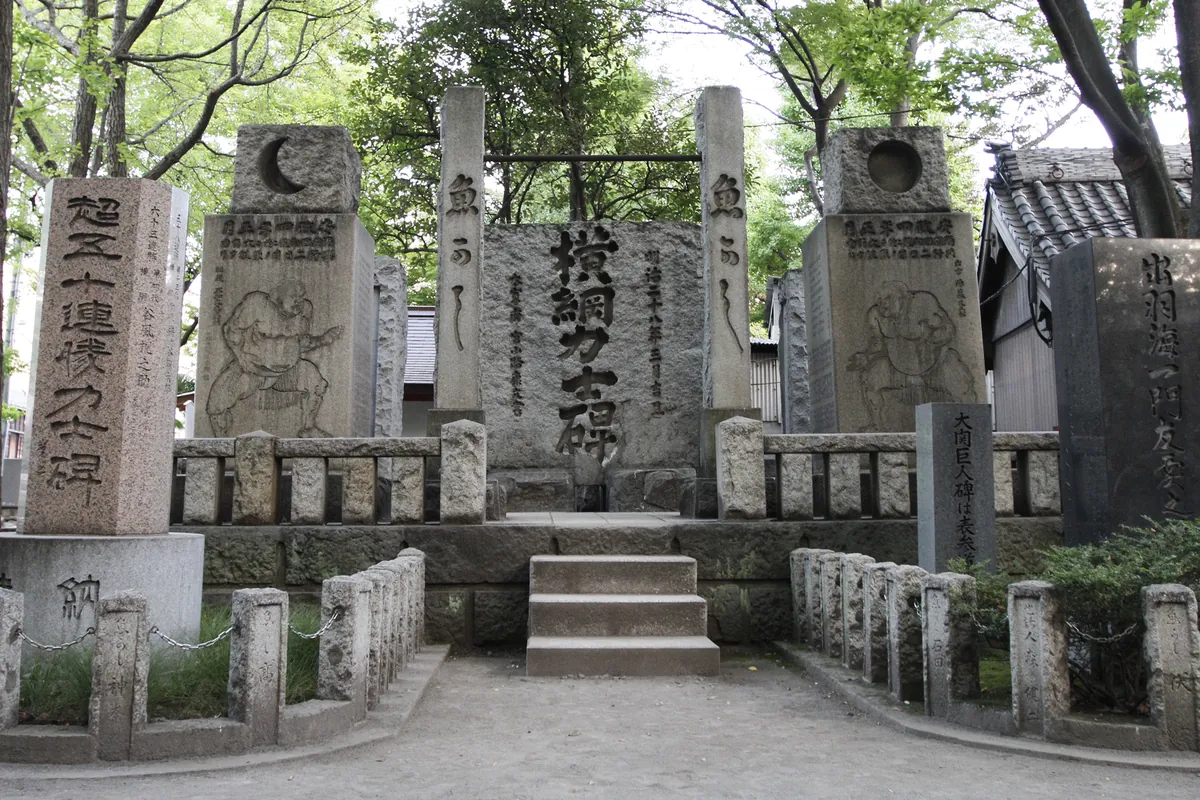
In 1684 sumo was permitted again in Edo, for charity events held on the grounds of Shinto shrines, and the first sanctioned tournament took place at Tomioka Hachiman Shrine in Fukagawa. The shrine is known as the birthplace of kanjin-zumō, the charity tournaments that are the origin of today's professional sport. Two tournaments a year were held there under the shogunate's permission, and the banzuke ranking sheet took shape in this period. Fukagawa is now part of Kōtō ward.
The Yokozuna Stone
In 1900 the twelfth yokozuna, Jinmaku Kyūgorō, raised a stone monument at the shrine to honour the yokozuna who came before him. It is inscribed with the ring names of every yokozuna, and English Wikipedia notes that when a wrestler is promoted to the rank, a ring-entering ceremony is performed at the shrine in dedication. Other sumo monuments stand in the same grounds.
Sunamura, the vegetable village
Sunamachi itself has humbler roots. Japanese Wikipedia says the name comes from the Sunamura family, who reclaimed the land in the Edo period, and that Sunamura was then a major farming area whose growers bred their own vegetables, including leeks and aubergines that carried the village name. It became the town of Sunamachi in 1921 and was folded into Tokyo City's Jōtō ward in 1932; in 1947 Jōtō merged with Fukagawa to form Kōtō.
East of the river
Kōtō means east of the river. The ward lies between the Sumida River and the Arakawa, and much of its northern half is old reclaimed land lying very low, in places below sea level. It belongs to shitamachi, the low town where Edo's merchants and artisans lived, as opposed to the hilly yamanote of the samurai. Sunamachi Ginza, the shopping street where the sumo session runs, keeps that working-neighbourhood character.
Frequently asked questions
Can I visit Tomioka Hachiman Shrine on the same day?
Yes. It is in Kōtō's Fukagawa district, in the western part of the same ward, and makes a natural pairing with the sumo session.
What is the Yokozuna Stone?
A stone monument raised in 1900 at Tomioka Hachiman Shrine by the twelfth yokozuna, inscribed with the ring names of the yokozuna.
Sources