The challenge
Stepping onto the dohyō yourself
What the optional ring challenge at Sunamachi involves: the mawashi, the changing area, who can take part and what the ring itself is made of.
Reserve a place by the ring ↗Quick answer
In the last half hour of the Sunamachi session, anyone who wants to can change into a mawashi in a private area and step barefoot onto the ring to wrestle one of the two former professionals. It is optional, the kit is provided, and children from four and women can take part.
What you actually do
After the explanation and the wrestlers' own training and bouts, the third part of the session hands the ring to the audience. Volunteers go to a private changing area, change into a mawashi, and step barefoot onto the dohyō. Then you square up to one of the wrestlers and push. The result is not in doubt, and that is the fun of it. You need no fitness or skill beyond being willing to have a go. People who would rather not wrestle can still step onto the ring when the bouts are over and pose with the wrestlers for photos.
The mawashi
The mawashi is the belt every sumo wrestler wears, wrapped round and round the waist and tied off behind in a big knot. In a bout it is also a handle: yorikiri, the most common winning technique, is a force-out made while gripping the opponent's belt or body. English Wikipedia notes that top-ranked professionals wear a white cotton mawashi in training and a coloured silk one in tournaments, while lower-ranked wrestlers wear black cotton for both. At Sunamachi the venue supplies a real mawashi and a full changing kit, so you can turn up in ordinary clothes.
What the ring is
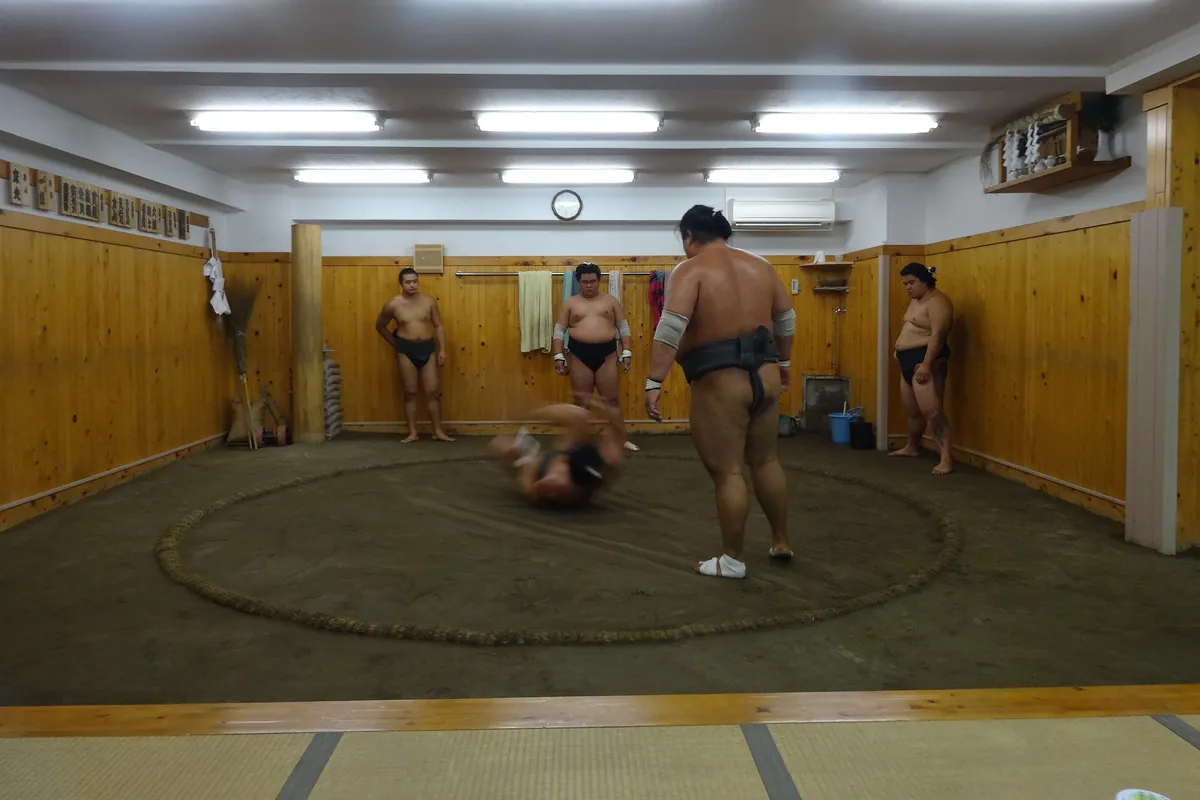
A dohyō is a circle 4.55 metres across, bounded by rice-straw bales partly buried in clay and topped with a layer of sand. Two short white lines in the centre mark where the wrestlers set themselves before the charge. For professional tournaments the ring stands on a raised clay platform that ring attendants rebuild each time; in training rooms it is laid flat on the floor but otherwise the same. You lose by stepping out of the circle or by letting any part of you other than your soles touch the clay.
Who can stand on it
Here, anyone in the group: men, women and children from four. That is a real difference from professional sumo, which bars women from the dohyō under a tradition rooted in Shinto and Buddhist beliefs about purity. Amateur sumo, by contrast, includes women's competition, and English Wikipedia lists women's weight classes at amateur tournaments. For many families, letting a daughter or a mother step onto the clay is the highlight of the afternoon.
Practical points
Come in whatever is comfortable; challengers change into the gear provided. You wrestle barefoot, so it helps to have clothes that are easy to change out of. The session is wheelchair accessible, and anyone who prefers to watch can stay seated through the challenge and still join the photos afterwards. Let children watch the wrestlers first and decide for themselves once the challenge begins.
Frequently asked questions
Do I need to be fit to try the ring challenge?
No. It is a short, friendly push against a former professional, and nobody expects you to win. It is optional.
Is the mawashi provided?
Yes. The venue provides a real mawashi and a full changing kit, and there is a private changing area.
Can children wrestle?
Yes. Children aged four and over can take part in the ring challenge.
Sources